Cognitive Processes "Which Lead to" Broken Family Bullying
Vygotsky's Sociocultural Theory of Cerebral Development
By Saul McLeod, updated 2020
The work of Lev Vygotsky (1934) has get the foundation of much research and theory in cognitive development over the past several decades, particularly of what has become known as sociocultural theory.
Vygotsky's sociocultural theory views homo evolution every bit a socially mediated process in which children acquire their cultural values, beliefs, and problem-solving strategies through collaborative dialogues with more knowledgeable members of lodge. Vygotsky'south theory is comprised of concepts such as culture-specific tools, private speech, and the Zone of Proximal Evolution.
Vygotsky's theories stress the fundamental role of social interaction in the evolution of cognition (Vygotsky, 1978), every bit he believed strongly that community plays a fundamental role in the procedure of "making meaning."
Unlike Piaget's notion that childrens' development must necessarily precede their learning, Vygotsky argued, "learning is a necessary and universal aspect of the procedure of developing culturally organized, specifically human psychological function" (1978, p. xc). In other words, social learning tends to precede (i.e., come before) development.
Vygotsky has developed a sociocultural approach to cognitive development. He adult his theories at around the same time as Jean Piaget was starting to develop his ideas (1920'south and thirty's), but he died at the age of 38, and so his theories are incomplete - although some of his writings are notwithstanding beingness translated from Russian.
No unmarried principle (such as Piaget'due south equilibration) can account for development. Individual development cannot be understood without reference to the social and cultural context within which information technology is embedded. Higher mental processes in the individual have their origin in social processes.
Vygotsky's theory differs from that of Piaget in a number of important ways:

1: Vygotsky places more emphasis on civilization affecting cognitive development.
This contradicts Piaget's view of universal stages and content of development (Vygotsky does non refer to stages in the way that Piaget does).
Hence Vygotsky assumes cognitive evolution varies across cultures, whereas Piaget states cognitive development is mostly universal beyond cultures.
2: Vygotsky places considerably more emphasis on social factors contributing to cognitive evolution.
(i) Vygotsky states the importance of cultural and social context for learning. Cognitive evolution stems from social interactions from guided learning within the zone of proximal evolution as children and their partner'south co-construct knowledge. In contrast, Piaget maintains that cognitive development stems largely from independent explorations in which children construct knowledge of their own.
(two) For Vygotsky, the environment in which children grow up will influence how they remember and what they think about.
three: Vygotsky places more (and different) accent on the office of language in cognitive evolution.
According to Piaget, language depends on thought for its evolution (i.e., thought comes before language). For Vygotsky, thought and linguistic communication are initially separate systems from the beginning of life, merging at effectually three years of age, producing exact thought (inner speech).
For Vygotsky, cerebral development results from an internalization of language.
4: According to Vygotsky adults are an important source of cognitive evolution.
Adults transmit their culture's tools of intellectual adaptation that children internalize. In contrast, Piaget emphasizes the importance of peers, as peer interaction promotes social perspective taking.
Effects of Culture: - Tools of intellectual adaptation
Vygotsky claimed that infants are born with the bones abilities for intellectual development chosen 'uncomplicated mental functions' (Piaget focuses on motor reflexes and sensory abilities).
Elementary mental functions include –
o Attention
o Sensation
o Perception
o Retention
Eventually, through interaction within the sociocultural surround, these are developed into more than sophisticated and effective mental processes which Vygotsky refers to as 'higher mental functions.'
Each culture provides its children tools of intellectual adaptation that allow them to use the basic mental functions more than effectively/adaptively.
Tools of intellectual accommodation is Vygotsky'south term for methods of thinking and trouble-solving strategies that children internalize through social interactions with the more than knowledgeable members of society.
For example, retentivity in immature children this is limited by biological factors. Notwithstanding, culture determines the type of memory strategy we develop. For example, in western culture, children learn note-taking to aid memory, only in pre-literate societies, other strategies must be developed, such as tying knots in a string to retrieve, or carrying pebbles, or repetition of the names of ancestors until large numbers can exist repeated.
Vygotsky, therefore, sees cognitive functions, even those carried out alone, as afflicted by the beliefs, values, and tools of intellectual adaptation of the civilisation in which a person develops and therefore socio-culturally determined. The tools of intellectual adaptation, therefore, vary from culture to culture - every bit in the memory instance.
Social Influences on Cerebral Development
Like Piaget, Vygotsky believes that young children are curious and actively involved in their ain learning and the discovery and development of new understandings/schema. However, Vygotsky placed more emphasis on social contributions to the procedure of evolution, whereas Piaget emphasized self-initiated discovery.
According to Vygotsky (1978), much important learning by the child occurs through social interaction with a skillful tutor. The tutor may model behaviors and/or provide verbal instructions for the child. Vygotsky refers to this every bit cooperative or collaborative dialogue. The child seeks to understand the actions or instructions provided by the tutor (often the parent or teacher) then internalizes the information, using it to guide or regulate their own functioning.
Shaffer (1996) gives the case of a immature daughter who is given her first jigsaw. Alone, she performs poorly in attempting to solve the puzzle. The father then sits with her and describes or demonstrates some basic strategies, such equally finding all the corner/border pieces and provides a couple of pieces for the child to put together herself and offers encouragement when she does so.
Every bit the kid becomes more competent, the male parent allows the child to work more independently. Co-ordinate to Vygotsky, this type of social interaction involving cooperative or collaborative dialogue promotes cognitive development.
In gild to gain an understanding of Vygotsky'southward theories on cerebral evolution, one must understand two of the main principles of Vygotsky's work: the More Knowledgeable Other (MKO) and the Zone of Proximal Development (ZPD).
More than Knowledgeable Other
The more knowledgeable other (MKO) is somewhat self-explanatory; it refers to someone who has a ameliorate understanding or a higher ability level than the learner, with respect to a particular task, procedure, or concept.
Although the implication is that the MKO is a instructor or an older developed, this is not necessarily the example. Many times, a child's peers or an adult'due south children may be the individuals with more than knowledge or feel.
For example, who is more than likely to know more about the newest teenage music groups, how to win at the most contempo PlayStation game, or how to correctly perform the newest trip the light fantastic toe craze - a child or their parents?
In fact, the MKO demand not be a person at all. Some companies, to back up employees in their learning process, are at present using electronic performance support systems.
Electronic tutors have also been used in educational settings to facilitate and guide students through the learning process. The key to MKOs is that they must have (or be programmed with) more than noesis about the topic being learned than the learner does.
Zone of Proximal Development
The concept of the More Knowledgeable Other is integrally related to the second important principle of Vygotsky'south work, the Zone of Proximal Development.
This is an of import concept that relates to the difference betwixt what a child tin can achieve independently and what a child can achieve with guidance and encouragement from a skilled partner.
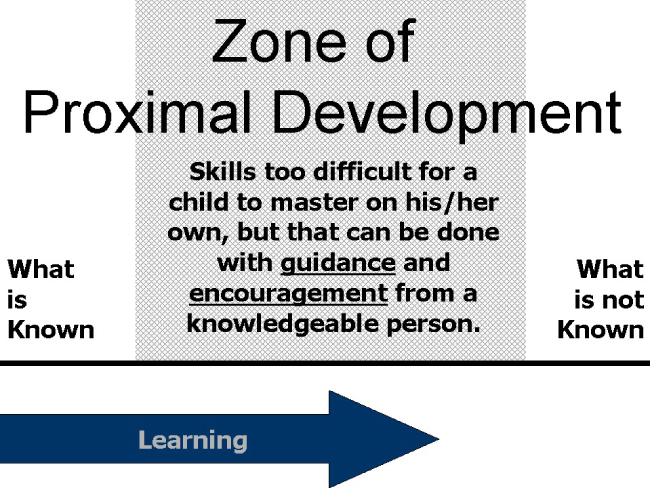
For example, the child could non solve the jigsaw puzzle (in the case above) past itself and would have taken a long fourth dimension to do and so (if at all), just was able to solve it following interaction with the father, and has developed competence at this skill that will exist practical to future jigsaws.
Vygotsky (1978) sees the Zone of Proximal Development as the surface area where the nearly sensitive instruction or guidance should be given - assuasive the child to develop skills they will and so use on their own - developing higher mental functions.
Vygotsky besides views interaction with peers every bit an effective fashion of developing skills and strategies. He suggests that teachers use cooperative learning exercises where less competent children develop with help from more proficient peers - within the zone of proximal development.
Evidence for Vygotsky and the ZPD
Freund (1990) conducted a study in which children had to decide which items of furniture should be placed in item areas of a dolls firm.
Some children were allowed to play with their mother in a like situation earlier they attempted it alone (zone of proximal development) while others were allowed to piece of work on this by themselves (Piaget's discovery learning).
Freund found that those who had previously worked with their mother (ZPD) showed the greatest improvement compared with their offset endeavour at the task. The conclusion being that guided learning within the ZPD led to greater agreement/performance than working solitary (discovery learning).
Vygotsky and Language
Vygotsky believed that linguistic communication develops from social interactions, for advice purposes. Vygotsky viewed linguistic communication as human's greatest tool, a means for communicating with the outside earth.
Co-ordinate to Vygotsky (1962) language plays ii critical roles in cognitive development:
1: It is the main means by which adults transmit data to children.
two: Language itself becomes a very powerful tool of intellectual adaptation.
Vygotsky (1987) differentiates between three forms of language: social speech which is external communication used to talk to others (typical from the age of two); private oral communication (typical from the age of iii) which is directed to the self and serves an intellectual part; and finally private speech goes undercover, diminishing in audibility equally it takes on a cocky-regulating function and is transformed into silent inner speech communication (typical from the age of vii).
For Vygotsky, thought and language are initially split systems from the kickoff of life, merging at around iii years of historic period. At this point spoken language and thought become interdependent: thought becomes exact, spoken communication becomes representational. When this happens, children's monologues internalized to get inner speech. The internalization of linguistic communication is of import as it drives cognitive development.
'Inner spoken communication is not the interiour aspect of external speech - information technology is a function in itself. It still remains voice communication, i.e., idea connected with words. But while in external speech thought is embodied in words, in inner speech words dies every bit they bring forth idea. Inner speech is to a large extent thinking in pure meanings.'
(Vygotsky, 1962: p. 149)
Vygotsky (1987) was the first psychologist to document the importance of individual oral communication. He considered private spoken communication every bit the transition bespeak between social and inner spoken communication, the moment in development where language and thought unite to found verbal thinking.
Thus private speech, in Vygotsky's view, was the primeval manifestation of inner speech. Indeed, private speech is more than like (in its form and role) to inner voice communication than social speech.
Private speech is 'typically divers, in contrast to social speech communication, as speech addressed to the self (not to others) for the purpose of cocky-regulation (rather than communication).' (Diaz, 1992, p.62)
Unlike inner voice communication which is covert (i.due east., hidden), private speech is overt. In contrast to Piaget'southward (1959) notion of private spoken communication representing a developmental dead-end, Vygotsky (1934, 1987) viewed private speech as:
'A revolution in development which is triggered when preverbal thought and preintellectual language come together to create fundamentally new forms of mental functioning.'(Fernyhough & Fradley, 2005: p. one).
In addition to disagreeing on the functional significance of private voice communication, Vygotsky and Piaget besides offered opposing views on the developmental course of private oral communication and the ecology circumstances in which it occurs most ofttimes (Berk & Garvin, 1984).

Through individual spoken language, children begin to interact with themselves in the same way a more knowledgeable other (e.yard., adults) collaborate with them in the achievement of a given function.
Vygotsky sees "private speech" every bit a means for children to plan activities and strategies and therefore assistance their development. Private speech is the utilise of linguistic communication for self-regulation of behavior. Language is, therefore, an accelerator to thinking/agreement (Jerome Bruner also views language in this way). Vygotsky believed that children who engaged in large amounts of private speech are more socially competent than children who do not employ it extensively.
Vygotsky (1987) notes that private voice communication does non merely accompany a child's activity but acts as a tool used by the developing child to facilitate cognitive processes, such equally overcoming task obstacles, enhancing imagination, thinking, and conscious awareness.
Children utilise private voice communication most often during intermediate difficulty tasks considering they are attempting to self-regulate by verbally planning and organizing their thoughts (Winsler et al., 2007).
The frequency and content of private speech are then correlated with behavior or performance. For case, private speech communication appears to be functionally related to cerebral performance: It appears at times of difficulty with a job.
For example, tasks related to executive function (Fernyhough & Fradley, 2005), problem-solving tasks (Behrend et al., 1992), schoolwork in both language (Berk & Landau, 1993), and mathematics (Ostad & Sorensen, 2007).
Berk (1986) provided empirical support for the notion of private speech communication. She found that most private spoken language exhibited by children serves to describe or guide the child'south actions.
Berk also discovered than child engaged in private speech more often when working lone on challenging tasks and also when their teacher was not immediately available to help them. Furthermore, Berk also found that individual speech develops similarly in all children regardless of cultural background.
Vygotsky (1987) proposed that private oral communication is a product of an private'south social environment. This hypothesis is supported by the fact that there exist high positive correlations between rates of social interaction and private speech in children.
Children raised in cognitively and linguistically stimulating environments (situations more often observed in higher socioeconomic status families) commencement using and internalizing individual speech faster than children from less privileged backgrounds. Indeed, children raised in environments characterized past low verbal and social exchanges exhibit delays in private oral communication development.
Childrens' use of private speech diminishes as they grow older and follows a curvilinear trend. This is due to changes in ontogenetic evolution whereby children are able to internalize language (through inner speech) in order to self-regulate their beliefs (Vygotsky, 1987).
For example, research has shown that childrens' private speech unremarkably peaks at 3–4 years of age, decreases at vi–7 years of age, and gradually fades out to be mostly internalized by historic period 10 (Diaz, 1992).
Vygotsky proposed that private speech communication diminishes and disappears with age not because it becomes socialized, as Piaget suggested, but rather because it goes underground to constitute inner speech or verbal thought" (Frauenglass & Diaz, 1985).
Classroom Applications
Vygotsky's approach to child development is a form of social constructivism, based on the thought that cognitive functions are the products of social interactions.
Vygotsky emphasized the collaborative nature of learning by the construction of knowledge through social negotiation.
He rejected the assumption made past Piaget that information technology was possible to separate learning from its social context.
Vygotsky believed everything is learned on two levels. First, through interaction with others, and and so integrated into the private's mental structure.
Every office in the child'due south cultural development appears twice: beginning, on the social level, and later, on the individual level; offset, betwixt people (interpsychological) and then inside the child (intrapsychological). This applies every bit to voluntary attention, to logical retentiveness, and to the formation of concepts. All the college functions originate equally bodily relationships betwixt individuals. (Vygotsky, 1978, p.57)
Instruction styles based on constructivism marking a conscious endeavor to move from 'traditional, objectivist models didactic, memory-oriented transmission models' (Cannella & Reiff, 1994) to a more student-centred approach.
A contemporary educational application of Vygotsky's theory is "reciprocal teaching," used to improve students' ability to larn from text. In this method, teachers and students interact in learning and practicing four key skills: summarizing, questioning, clarifying, and predicting. The instructor's role in the process is reduced over fourth dimension.
Too, Vygotsky theory of cerebral development on learners is relevant to instructional concepts such as "scaffolding" and "apprenticeship," in which a teacher or more advanced peer helps to structure or arrange a job so that a novice tin can work on it successfully.
Vygotsky'southward theories also feed into the current involvement in collaborative learning, suggesting that grouping members should have different levels of ability so more avant-garde peers can help less advanced members operate within their ZPD.
Disquisitional Evaluation
Vygotsky's piece of work has non received the aforementioned level of intense scrutiny that Piaget'due south has, partly due to the time-consuming process of translating Vygotsky'south work from Russian. Also, Vygotsky'south sociocultural perspective does not provide every bit many specific hypotheses to test as did Piaget's theory, making refutation difficult, if non impossible.
Perchance the primary criticism of Vygotsky'south piece of work concerns the assumption that it is relevant to all cultures. Rogoff (1990) dismisses the idea that Vygotsky's ideas are culturally universal and instead states the concept of scaffolding - which is heavily dependent on verbal instruction - may not be equally useful in all cultures for all types of learning. Indeed, in some instances, observation and practise may be more than constructive ways of learning certain skills.
How to reference this article:
How to reference this article:
McLeod, S. A. (2018, August 05). Lev Vygotsky. Simply Psychology. www.simplypsychology.org/vygotsky.html
APA Fashion References
Behrend, D.A., Rosengren, M.S., & Perlmutter, M. (1992). The relation between individual spoken communication and parental interactive style. In R.M. Diaz & L.Due east. Berk (Eds.), Private speech: From social interaction to self-regulation (pp. 85–100). Hillsdale, NJ: Erlbaum.
Berk, L. E. (1986). Relationship of elementary school children'south private speech to behavioral accessory to task, attention, and chore performance. Developmental Psychology, 22(v), 671.
Berk, L. & Garvin, R. (1984). Development of private spoken language amongst low-income Appalachian children. Developmental Psychology, 20(2), 271-286.
Berk, 50. E., & Landau, South. (1993). Private speech of learning-disabled and normally achieving children in classroom academic and laboratory contexts. Kid Development, 64, 556–571.
Cannella, Chiliad. S., & Reiff, J. C. (1994). Individual constructivist teacher instruction: Teachers as empowered learners. Instructor education quarterly, 27-38.
Diaz, R. M., & Berk, 50. E. (1992). Individual speech: From social interaction to self-regulation. Lawrence Erlbaum.
Frauenglass, 1000. & Diaz, R. (1985). Self-regulatory functions of children'southward individual oral communication: A disquisitional analysis of recent challenges to Vygotsky'south theory. Developmental Psychology, 21(2), 357-364.
Fernyhough, C., & Fradley, E. (2005). Private speech communication on an executive task: Relations with task difficulty and task performance. Cognitive Development, 20, 103–120.
Freund, L. S. (1990). Maternal regulation of children's problem-solving behavior and its impact on children's performance. Child Development, 61, 113-126.
Ostad, S. A., & Sorensen, P. M. (2007). Private spoken communication and strategy-use patterns: Bidirectional comparisons of children with and without mathematical difficulties in a developmental perspective. Periodical of Learning Disabilities, 40, 2–14.
Piaget, J. (1959). The language and idea of the child (Vol. 5). Psychology Press.
Rogoff, B. (1990). Apprenticeships in thinking. New York: Oxford University Press.
Schaffer, R. (1996). Social development. Oxford: Blackwell.
Vygotsky, L. S. (1962). Thought and linguistic communication. Cambridge MA: MIT Printing.
Vygotsky, Fifty. South. (1978). Mind in society: The evolution of higher psychological processes. Cambridge, MA: Harvard University Printing.
Vygotsky, L. Southward. (1987). Thinking and voice communication. In R.W. Rieber & A.S. Carton (Eds.), The collected works of 50.S. Vygotsky, Volume 1: Issues of general psychology (pp. 39–285). New York: Plenum Press. (Original work published 1934.)
Winsler, A., Abar, B., Feder, M. A., Schunn, C. D., & Rubio, D. A. (2007). Private spoken communication and executive functioning amidst loftier-functioning children with autistic spectrum disorders. Periodical of Autism and Developmental Disorders, 37, 1617-1635.
How to reference this article:
How to reference this article:
McLeod, S. A. (2018, August 05). Lev Vygotsky. Merely Psychology. world wide web.simplypsychology.org/vygotsky.html
Home | About Us | Privacy Policy | Advertise | Contact U.s.a.
But Psychology's content is for informational and educational purposes merely. Our website is not intended to be a substitute for professional person medical communication, diagnosis, or treatment.
© Simply Scholar Ltd - All rights reserved

Source: https://www.simplypsychology.org/vygotsky.html

Post a Comment for "Cognitive Processes "Which Lead to" Broken Family Bullying"