Des Moines Art Center Print Club Des Moines Iowa
 | |
 | |
| Established | 1948 |
|---|---|
| Location | 4700 Grand Avenue Des Moines, Iowa |
| Manager | Jeff Fleming |
| Website | www |
| Des Moines Art Center | |
| U.S. National Register of Celebrated Places | |
| Show map of Iowa Show map of the United States | |
| Location | 4700 Grand Ave., Des Moines, Iowa, United States |
| Coordinates | 41°35′02″Due north 93°40′54″W / 41.58389°N 93.68167°W / 41.58389; -93.68167 Coordinates: 41°35′02″N 93°forty′54″W / 41.58389°N 93.68167°Westward / 41.58389; -93.68167 |
| Congenital | 1948 |
| Architect |
|
| Architectural fashion | International Mode |
| NRHP referenceNo. | 03000063[i] |
| Added to NRHP | October xix, 2004 |


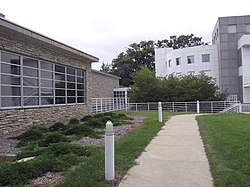
The Des Moines Art Center is an fine art museum with an all-encompassing collection of paintings, sculpture, modern fine art and mixed media. It was established in 1948 in Des Moines, Iowa.[2]
History [edit]
The Art Center traces its roots to 1916, when the Des Moines Association of Fine Arts established gallery space at the Public Library of Des Moines on the banks of the Des Moines River downtown. Several exhibitions were shown each year, and works of art were periodically purchased for the association's permanent drove. In 1938, the DMAF moved their drove to a building on Walnut Street.[3] Planning for a permanent building began in 1943 afterwards a sizeable donation from the trust of James D. Edmundson.[4] In 1945, DMAF evolved into the Des Moines Art Center.[5] A site forth Grand Avenue in the city's Greenwood Park was designated as the preferred location. Structure began in 1945; the museum itself opened in 1948, with additional wings synthetic in 1968 and 1985.
In 2009, the Art Centre expanded its mission to operate the Pappajohn Sculpture Park, located in Western Gateway Park downtown.[6]
Collection [edit]
Artists included in the permanent collection are Edward Hopper, Jasper Johns, Andy Warhol, Henri Matisse, Claude Monet, Francis Bacon, Georgia O'Keeffe, Gerhard Richter, Claes Oldenburg, Mary Cassatt, Auguste Rodin, Grant Wood, Deborah Butterfield, Paul Gauguin, Eva Hesse, Ronnie Landfield, Roy Lichtenstein, George Segal, Mark Rothko, John Singer Sargent, Joseph Cornell and Takashi Murakami.
Some paintings from the drove are well known examples of the artist and/or movement they represent. These include Edward Hopper's Automat from 1927, which was reproduced on a stamp too as used for a cover of Fourth dimension, Stanton MacDonald Wright's Synchromy which has been reproduced in numerous texts about the artist/move, Francis Bacon's Portrait of Pope Innocent from 1953 which besides is considered a signature work by the artist and appeared in Robert Hughes "Daze of the New" BBC series in the early on 1980s.
Facilities [edit]
A big main gallery rotates through several exhibitions throughout the twelvemonth, virtually of which are featured from one to three months at a time. These shows include solo shows by internationally recognized artists, travelling shows from other institutions, and group shows organized effectually a theme. The rest of the museum space highlights the permanent collections in various ways, including modest spaces for short-term print and photography shows, a video gallery, and long-term installations organized both chronologically and thematically. Included on the grounds are outdoor sculptures and a rose garden. An external reflecting pool is surrounded on all sides by the museum.
The architecture of the original museum wing was designed in a combination of Art Nouveau and Art Deco styles past Eliel Saarinen in 1945 and completed in 1948.
The 2nd addition, originally intended for large-scale sculpture, was designed in a Modernist style past I.Yard. Pei in 1966 and completed in 1968. Legend says that Pei designed the southward windows, which look out onto the rose garden, to resemble "PEI", only he has denied this.
The 3rd wing was designed by Richard Meier and completed in 1985. This wing was designed to allow as much natural ambient light in as possible.
The Art Eye also includes a eatery and a souvenir store. Workshops, film festivals and lectures are conducted on a regular ground through the museums big studio programme, with classes available for students of all ages.
References [edit]
- ^ "National Register Information Organization". National Register of Historic Places. National Park Service. July 9, 2010.
- ^ "Museum History". Des Moines Art Center. Archived from the original on 2009-08-31. Retrieved 2009-07-18 .
- ^ joe (9 August 2016). "Key Art Gallery". Archived from the original on xxx June 2019. Retrieved 15 February 2018.
- ^ "Architecture - Des Moines Art Heart". world wide web.desmoinesartcenter.org.
- ^ "Archived copy" (PDF). Archived from the original (PDF) on 2021-05-06. Retrieved 2018-02-fifteen .
{{cite web}}: CS1 maint: archived copy every bit title (link) - ^ "John and Mary Pappajohn Sculpture Park - Des Moines Art Center". world wide web.desmoinesartcenter.org.
External links [edit]
- Official website
Source: https://en.wikipedia.org/wiki/Des_Moines_Art_Center

Post a Comment for "Des Moines Art Center Print Club Des Moines Iowa"